Tuesday, February 27, 2007

A Different Kind of Numbers Campaign - St. Lawrence University, NY

St. Lawrence University's chapter of Democracy Matters recently organized a different kind of numbers campaign. We decided to focus on the number one billion, the estimated campaign cost for the 2008 presidential election. Instead of just posting flyers around the campus, our group brainstormed a new way to communicate this information to the student body.

Last year, a display in our student center attempted to raise awareness for rape and sexual harassment by stringing lines ofcolored T-shirts across the atrium, right where students walk everyday to eat, check their mail, attend events, or socialize with friends. With this idea in mind, our group came up with the idea of hanging strands of Democracy Matters bills across the student center atrium.

During one club meeting, we taped one thousand bills to strings, with the idea that each bill equaled one million dollars. This meant that the bills in our display represented one billion dollars. Our club spent some extra time that night hanging up the bills in long, drooping lines across the student center. The finished product was striking, obvious to anyone who walked through the student center. This display was accentuated with posters saying ONE BILLION, an explanatory sign in the student center, and emails
explaining the display.

Our goal was to educate people about the extravagant campaigning that is in our near future for the 2008 presidential election and the purpose of Democracy Matters. It seemed to spark an interest in some people, as many club members had discussions about the display with friends. One new person came to our meeting because of her interest in the display.

Altogether, the campaign was a success. We accomplished our goal of educating the campus about the existence of dirty money in politics. If we were to do it again, we could try to engage the campus more by holding campus discussions or a speaker on the subject of clean elections. We also could have more explanatory signs that were even more noticeable to the people passing through. However, for our first attempt at a different kind of numbers campaign, we are extremely pleased with the results. We would encourage other campuses to give it a try!

-Erin Griffin
St. Lawrence University

Sunday, January 28, 2007

Petition Drive - Vanderbilt University, TN

The 2006 mid-term election for the Tennessee Senate was extremely competitive. Both Bob Corker (R) and Harold Ford, Jr., (D) raised huge sums of money in an attempt to gain the upper hand in such a tight race. Bob Corker, who ended up raising more money, eventually won. To raise awareness about money in politics, Democracy Matters at Vanderbilt University decided to welcome our new Senator with a petition drive. In the midst of a major ethics reform in the Senate, our goal was tell our newly-elected Senator Corker to keep an eye on the issue of money in politics and work toward Clean Elections. We set a goal of 250 signatures and began planning.

With the fall semester closing and finals week near, our group had to make the most of our time. My Staff Link Daryn Cambridge and I discussed various strategies to get as many signatures as possible in as little time. Although it would have been nice to go around as an entire group and get signatures, we though there would be a lot of dead weight and only one or two people doing the talking. Instead Daryn suggested each member take a half hour after lunch or dinner during the week and go around the cafeteria gathering signatures. We thought this strategy would be most effective since everyone was on different finals schedules, our members had to eat sometime during the day, and the cafeteria was a gathering place for hundreds of potential signers.

Although I think we picked the best strategy, our group hit some bumps along the road. Some members understandably put finals before the petition drive, gathering few or no signatures at all. Also since members were on their own, some put it off to the last minute, gathering only a small amount. A particularly successful group of three gathered over sixty signatures just going around to dorm rooms that had their doors open. They said they were so successful because they had a couple people to socialize with, which made the tedious work more enjoyable. I made an announcement about the petition in my American Government class and also carried the petition around in my backpack throughout the week.

When the semester ended, we had about ninety signatures. After a relaxing winter break, we resumed our petition drive, striving for that 250 signature mark. At the first meeting back, however, only about five members showed up. I think everyone was busy getting settled in and preparing for the semester ahead. Also, Vanderbilt has a huge Greek scene and rush week was in full force. I tried to take advantage of this busy week by passing the petition around at a meeting for my fraternity. My roommate and I also went around the cafeteria once more. Ultimately, however, we fell short of the 250 mark by about 110 signatures. Considering the circumstances, maybe 250 signatures was out of reach, but it is better to challenge yourself and fail than to have an easy goal and succeed. Hopefully, Senator Corker will write back, possible starting a continuous dialogue with Democracy Matters. If not, 140 more people know about Democracy Matters and Clean Elections.

Tom Byrne

Democracy Matters Campus Coordinator

Vanderbilt University

Sunday, December 24, 2006

Democracy Matters at Hawaii

Democracy Matters is an organization that allows progressive minds, at perhaps their greatest effectiveness, to successfully focus their talents and skills for a positive change that will significantly influence the world in which we all live. Working inside this group lets individuals have a strong voice in our society because you gain the ability to educate yourself on the importance of “Clean Elections,” educate others on its importance, and become part of the larger portrait that is demanding voter owned elections in our country.

The number one key to becoming an effective campus coordinator for Democracy Matters is education. The first step is trying to fully understand the importance of taking special interests out of our politician’s pockets. You don’t have to know all the details of our political process, but it helps to do some research on how campaign donations from corporations have swayed our representatives’ votes for far too long. The “special interests” that campaign contributions have led to means an increase in social and economic inequalities and a decline in our society’s safety net for the majority of the population. Almost any way you look at it, publicly financing campaigns would decrease political corruption, allow for more progressive legislation to pass, and increase democratic decision making processes in our country.

With a little education under my belt, I have been able to go out into my community and educate others on the importance of clean elections. This is not an easy task, but like they say, there’s many ways to skin a cat. Some of the tactics that I used this past year were holding weekly meetings on campus and drawing other students into my Democracy Matters group, then holding events with my group like “Call in Days” where we encouraged various people on campus to call our Reps to support the “clean election” cause. Plus, we also did “class-raps” because they’re a great way to educate a big group a people at one time about the importance of this movement.

Lastly, but just as importantly as educating yourself and others, is to form coalitions with various local organizations, and those dedicated to working on this project are especially helpful. I personally worked hand in hand with Voter Owned Hawaii (VOE) and they were wonderful, but one could go to almost any NGO in their community for assistance. Kory from VOE helped me with physical, mental, and emotional support for my events that I desperately needed at times. I can almost guarantee that anyone else working events will feel the same way; the more help, the better. Or to quote an old striker’s song, “The more we get together the happier we’ll be”.

This is the trinity of knowledge that I have gained from working this past semester with Democracy Matters, I hope it helps because the sooner we get this progressive legislation passed the sooner we can get on with saving our world.

Jenny Knippling

Democracy Matters Campus Coordinator, Hilo, Hawaii

Monday, December 4, 2006

Democracy Week - Colgate University, NY

Although DM has been a constant and known presence on the Colgate campus for years, it is easy for many people to ignore us. So at the end of last semester we decided to make it nearly impossible for anyone on campus to ignore our group by hosting an entire week of events. And three months later, in late September, everyone on campus knew it was Democracy Week. With a crowd of almost 300 at our big event, democracy week was a huge success. We received the Campus Life Award for our work registering voters and the events of Democracy Week. The week was the product of a lot of hard work, but it was also a lot of fun and a great way to get the word out about clean elections. Here are some tips for planning a week of Dm events:

  1. Start Early
    • Because we began planning early for this week, we were able to step back and set the dates in a strategic way. We planned the week for a time early in the semester to catch the eye of incoming freshman, but late enough not to get encompassed by welcome back activities.
    • You can also make sure to avoid other big speakers or events by getting your events on the calendar first!
    • By giving members important tasks from day one you retain membership much better.
    • When you are planning such a large-scale operation there is no way you can pull everything off in a short period of time. Giving yourself a lot of time enables you to make all the appropriate contacts and reach out to many facets of the community.
  1. Create a Focus to the week or Big Event
    • In order to draw attention and crowds, center your week around one main event. We were lucky enough to have Adonal come speak. But looking for a well known speaker or any event that would be sure to illicit a lot of attention in the media and community.
    • Because of Adonal’s speech, faculty and administration will be drawn to the week. Will the support of these groups you can receive extra funding
    • Also, a big speaker draws the attention of the media. Your school paper and hopefully local media outlets will want to cover you big event providing an outlet for you to talk about Clean Money and the rest of the events in your week.
  1. Outreach to other groups
    • The support and cosponsorship of other groups is key. By reaching out to other groups you will get more diverse and higher attendance at events.
    • Outreach is another reason the big event is important. Other groups will be attracted to a big name and then you can talk to them about the smaller events.
    • Take advantage of other groups at your school and incorporate them into the week. For example, we asked the debate team to put on a debate about Clean Elections. We also got the Activities Board to show The Tom Delay Movie in a big Auditorium. By engaging other groups in the week, you create a broader appeal and decrease your own workload.
  1. Outreach to the Community
    • The support of the community was an invaluable addition to Democracy Week.
    • We contacted local media outlets, gave presentations in the high school, and invited the community to all of our events.
    • The local community showed high interest in our issue, and through these events made more contacts with people who want to get involved.
  1. Seek guidance from experienced faculty and administrators
    • When we confirmed that Adonal would speak, we contacted the President of the University. She signed on as a copsonsor, offered to aid in funding, and put us in touch with key administrators.
    • Meeting with Deans is a very helpful tool in learning how to put on large scale events. The dean I met with gave me a long list of people to contact within the University that would help in advertising, publicity, catering, and scheduling. He also told me which professors to contact.
    • If you have a big event, let professors know early so they can put it on their syllabus.
    • We were also able to get cosponsorship from a center on campus that brings speakers. This center was instrumental in the planning and funding for the big event.
    • Use people who have planned these type of events before, and look for funding everywhere!
  1. Use your staff link
    • Don’t forget to ask your staff link for help. They have experience in planning these events too and will make sure you are covering all your bases.
  1. Delegate tasks
    • Planning this type of event takes A LOT of time and energy. Get your members involved early or you will be sorry later!
  1. Advertise, Advertise, Advertise
    • One of the most important aspects of a week like this is advertising. Because there will be a series of events you can create posters listing all the events.
    • Explore other forms of advertising as well: We spray painted sheets, sent out emails, went to groups and clubs, hung up tons of posters, passed out flyers, and tabled.
    • We also used events earlier in the semester to advertise as well. For instance when we registered the freshman class during orientation, we were able to speak to all of them about the upcoming week of events.
  1. Recruit New Members
    • Don’t forget to use this opportunity to recruit new members. Put sign up sheets at every event.
    • Mention meeting times at every event and give people a way to take action!

Colgate Democracy Week Events:

Voter Registration all week long

Monday – Kicked off the week with a “splash on campus” – We put condoms with clean elections facts in the dining halls.

Tuesday – Debate Team debated the merits of a federal CMCE bill.

Wednesday – Brown Bag lunch panel of Professors and Students “Student Activism: Then and Now”

Thursday – Adonal Foyle talk “Playing the game of democracy: an NBA player speaks out” with reception to follow.

Friday – Adonal Foyle visit to Colgate Bookstore – talk on banned books

- Colgate Activities Board presented “The Big Buy: Tom Delay’s Stolen Congress”

Wednesday, November 29, 2006

Op-ed Media Campaign - Kenyon College, OH

Op-eds and other forms of mass media are a great way to educate the public and deliver a message. All the East Coast college coordinators wrote op-eds about the mid-term election, corruption, and clean election reform and submitted them to their school paper and a local/community paper. The following op-ed was written by Karl Stark, campus coordinator at Kenyon College in Ohio. Enjoy!


According to the pollsters, newspapers, candidates and any radio show host, this year’s midterm elections were a “referendum on Iraq.” That may very well be. Approval ratings dropped without any policy change from the White House or the Hill, and challengers made it the nucleus of their campaigns.

But this year’s elections were about more than just Iraq. They were about more than rising health care costs, high unemployment and environmental concerns. The midterm elections were, quite simply, a referendum on accountability. It might have all started with Tom Delay, but it probably went back further than that, further than Verizion eavesdropping and Jack Abramoff. It goes back even further than Katrina. It started, ironically, with the Republican Party’s own: Newt Gingrich.

In 1994, Gingrich and the GOP took back the House for the first time in 40 years. Gingrich proposed his “Contract with America,” which promised the American people a smaller, more efficient, and more accountable government run by the Republican Party. “Tired of the pork-barrel politics?” Gingrich asked, “Give us a shot.” From then on, the public has held a watchful and disapproving eye over its politicians.

The events of the last two years have shown what happens when power is taken as an entitlement. As the Republican Party was able to pull off political victory after political victory, it became, in the eyes of its own members, more and more indestructible. And with House reelection percentages above 90% and the President having just wrapped the last campaign of his political career, there seemed to be little threat to the seats of power. This is exactly where the problem lies. The campaign cycles are kicking off earlier and earlier, to the point that many members are building their 2008 campaigns as we speak. Policy is secondary to fundraising. Instead of meeting with the National Education Association or the United Auto Workers, politicians are booking lunches with lobbyists and fat-walleted donors.

You’re thinking, “This isn’t news, so what’s the big deal?” Here’s the deal: I’m going to tell you how we fix it.

Currently in Maine and Arizona, and selected other races nationwide, public financing is the norm for political campaigns. Candidates, instead of being backed by affluent individuals, Political Action Committees, and lobbyists, are instead only financed through public contributions, each of which is capped to a predetermined per capita limit. On current national tax forms, individuals can select to have $3 placed into a national pot to help fund presidential candidates (FYI-the first candidate to ever refuse any public funding is…President Bush). The system of public financing for local and congressional races works similarly. That amount might be raised to $5 or $10, and would then be divided up between candidates who wished to use it. It is this optional nature which makes the system constitutional.

Public financing’s positive effects are staggering. For one, it levels the playing field for campaigns. It really makes the campaigns about the issues, as candidates cannot rely on hefty donations from Special-Interest groups to pay for high-profile TV commercials and mass mailings. Each candidate’s campaign is tied tightly to the public. In addition, politicians who are elected don’t have to worry about fund-raising once they’re in office, meaning that they can get down to business. Candidates who have run these “clean money” campaigns see their approval ratings jump.

Public financing isn’t just another “only in theory” campaign finance solutions. It is THE solution. It is being implemented nationwide. Last year, Connecticut passed new public financing legislation, and in Maine over 70% of the state government was elected through public financing. It can work, it will work, it DOES work.

Want more information on how to change politics in America? I’m Kenyon’s coordinator for Democracy Matters, a nationwide institution whose goal is to implement public financing across the country. It was, in fact, a Democracy Matters chapter that helped change Connecticut’s system. Reform is not just an election-year necessity, for real reform takes time, energy, and people. Email me at starkk@kenyon.edu, or visit www.democracymatters.org. Kenyon’s chapter will be showing a recent PBS documentary on clean elections, and we also hold regular meetings, so contact me to get involved!

Monday, November 27, 2006

Smack Down Your Vote - Bloomsburg University, PA

On November 7th, 2006 Bloomsburg University’s chapter of Democracy Matters hosted a get out the vote drive called “Smack Down Your Vote.” The obvious purpose of the event was to remind students to vote. Based on previous experience, for an event this big to be successful three things are required, the first is free food, the second is loud music, and the third is talking with professors. Once students hear about free food the word spreads like a wild fire and when anyone hears loud music, usually most people will instinctively want to check it out. The most important part of setting an event up is talking with professors before hand. Meeting with any professor face to face and telling them, what your event is and what you planned is key. Also from this meeting, if you can tailor the event towards something the professor is teaching in class this will increase your chances of getting students to attend. The most important part of meeting with a professor is asking them if they can either require their class to attend the event or offer extra credit. It is very different when you put them on the spot and ask them face to face instead of through an email.

Along with the three key components, we invited the University Democrats and College Republicans in a debate. They debated issues such as Iraq, Iran, Tuition, Economic policy, taxes etc. Later in the day, they talked about why you should vote for their specific candidate. They debated each candidate who would be on the ballot.

Throughout the day, we provided voter guides for students who attended. The voter guides were strategically placed near the food so students would have to walk by them to get to the food. Theses guides contained the candidate’s views on issues such as Tuition, Student Loans, Iraq, Corruption/Ethics, and various other hot button issues.

Advertising the event took time and effort. We started preparing for the event almost a month before Election Day. We made fliers, table tents, wrote a press release, spoke in classes, and had our advisor send an email to all faculty, multiple times. The table tents had all kinds of stuff on them such as free food, learning about who to vote for, and the location and the times things were taking place.

The biggest challenge when organizing this event was planning. Reserving a room big enough, getting a band to commit to the event, ordering the food, paying for the food, getting permission to put the table tents in the eating areas, talking to enough professors, printing all the materials, researching the candidates views and making sure the Democrats and Republicans were ready to debate proved to be a daunting task that required the involvement of all of my members.

Despite the tremendous amount of time it took to plan the event, we made a huge impact. Almost 400 students voted who lived on campus and more than 200 off campus voted. This had a tremendous impact on the local state representative race and it was because of our efforts.

The lessons learned from this event are planning is everything and every member needs to help. If you do not give yourself enough time to get what you want done, you cannot do it last minute and you cannot do it yourself. The more members you can delegate things too the better. It is better for you because you will not go insane trying to do everything and when people are involved they will want to stay involved.

John Latini Jr.

President – Campus Coordinator

Democracy Matters

Bloomsburg University

orgs.bloomu.edu/budm

Party at the Polls - UM Twin Cities, MN

Hi, it’s Joe from University of Minnesota, Twin Cities

We have had a very busy and largely successful semester at the University of Minnesota Twin Cities. We’ve hosted a large outdoor concert, started a website, held a lecture event featuring now promin
ent Congressman Keith Ellison, printed t-shirts, cosponsored two debates, printed voter guides, and run our usual business of tabling and recruiting. These things all undoubtedly helped to advance the cause of Democracy Matters and retaking democracy. However, none of them had the impact or were as rewarding as our Party at the Polls.

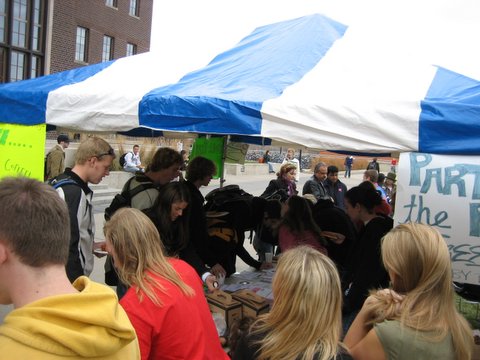
The premise of Party at the Polls was to attract a crowd near the polling place, ultimately increasing turnout. When we were planning our party, we realized that at the U of M, gathering a crowd is never a problem. Every day the central polling place on campus, Coffman Union, is packed with people. The problem with Coffman Union, however, is that most students cannot vote there. We decided to take a different approach. We would take the great mass of confused, would-be-voters and transform them into a mass of informed voters-to-be.

Our Party was planned by a team of five group members with one of them specifically in charge of the event. Besides planning, the preparatory work included renting a tent, ordering pizza, buying groceries, printing information, picking a space, making posters, and securing a permit.

The planning stage was focused on how to efficiently get information out to large numbers of people. Minnesota has the option of same-day registration, so we needed to tell people both how and where to vote. This was complicated by the fact that we needed to know which of the over 10 polling locations near campus to send students.

Our solution was hand-outs and laptops. Each person received a hand-out describing what they needed to register. If that person didn’t know which polling place they belonged at, we found it for them by searching for their address at our Secretary of State’s website.

Activities on election day included setting up the tent, making coffee and hot cocoa, and staffing the tables. For six hours during the day we answered questions, distributed food, found polling places, gave directions, and told people, “No, I’m sorry, you can’t just vote at Coffman Union, you have to go to your precinct.”

A group of foreign visitors stopped by our tent. They had come from south-eastern Asia to observe our elections process and to understand how our democracy functions. They spent a lot of time talking to us just trying to figure out why on earth we were out there. They thought for sure that we must be supporting some party or candidate. That we were there just for democracy, just because we believed that everyone should have their voice represented, even if it differs from our own, was almost too much to get by the language barrier. It was a moment where we had this sudden realization that our work really was affecting something. The Party at the Polls was a direct way for us to help our democracy. Most of our group’s efforts are indirect. They are aimed at education or influencing decisions that promote legislation which would benefit our democracy. By helping people to vote, though, we were working at the ground level of what makes our democracy work. By our best estimates over 700 people stopped by our tent about half of which were missing some piece of essential information. The sheer number of people that we were able to help made us realize that our work really does matter.